
Zanzibar is the Indian Ocean archipelago off Tanzania's east coast — Unguja, Pemba, Mafia, and a constellation of smaller islands. White-sand beaches, dhow-dotted turquoise water, the UNESCO-listed Stone Town, and the freshest spices in East Africa. Plan seven nights, book between June and October or December and February, and pair it with a Northern Circuit safari.
The first thing you notice in Zanzibar is the colour of the water. Not blue. Not turquoise. A specific shade of pale jade that exists nowhere else we have travelled, produced by white coral sand catching tropical light through clear water just a few metres deep. Photographs do not capture it. The eye barely captures it.
The second thing is the air. Cloves and cinnamon drift across the island from the spice plantations that once made Zanzibar the wealthiest port in East Africa. The Sultans grew rich on it; Stone Town's stone houses were built on it; the island's name has carried it for centuries. Spice Island, still.
This guide is the framework our concierge team uses to plan Zanzibar holidays for clients across the United States, the United Kingdom, Germany, France, and Australia — most often as the closing chapter of a Tanzania safari. It covers what the archipelago actually is, which beach to choose for which traveller, the tides nobody warns you about until you arrive, what it costs, and how to layer it with a Northern Circuit safari into the trip our clients still talk about a decade later.
What Zanzibar Actually Is
Zanzibar is a semi-autonomous archipelago of Tanzania, sitting roughly 30 kilometres off the East African coast in the Indian Ocean. Most travellers conflate the name with the main island, Unguja — but Zanzibar properly refers to the full archipelago, which includes:
- Unguja: the main island, 90 km long, 40 km wide. Where most beach holidays happen.
- Pemba: a quieter sister island 50 km north of Unguja. Among the finest diving in the Indian Ocean.
- Mafia Island: further south, less developed, whale sharks October through March.
- Mnemba Island: a tiny private island off Unguja's northeast coast. One lodge. One of the most exclusive island stays in the world.
Historically, Zanzibar was the seat of an Omani sultanate that controlled the East African coast, the spice trade, and — until 1873 — the largest slave market on the continent. The cultural layering shows: Swahili at the foundation, Omani Arab in the architecture and family names, Indian and Persian in the food, British in the road system and the legal code. Zanzibar was the birthplace of Swahili culture itself, and of one Farrokh Bulsara, born in Stone Town in 1946 and known later as Freddie Mercury.

The Beaches: An Honest Region-by-Region Guide
Most marketing pages describe every Zanzibar beach as paradise. The truth is more useful: each beach has a personality, and the wrong choice for the wrong traveller produces a meaningfully worse holiday. The single most important variable is tide — discussed in detail below — but personality matters too.
The North: Nungwi & Kendwa
The northern tip of Unguja. The only stretch of beach on the main island that is genuinely non-tidal — meaning the water remains swimmable at any state of the tide. Wide white sand, turquoise water, lively dhow harbour at Nungwi, full-moon parties at Kendwa. The trade is that this is where everyone goes who wants to swim — beaches here are busier than the east coast, with more vendors, more music, and more visible nightlife. For travellers who prioritise all-day swimming and a buzzy atmosphere, this is the right answer.
The Northeast: Matemwe
Quieter, upmarket, and the closest land base to Mnemba Atoll — the most celebrated dive and snorkel site in Zanzibar. Tidal, meaning swimming and snorkelling work best at high tide. Houses some of the island's best mid-luxury and luxury lodges, including Matemwe Lodge and Zuri Zanzibar. The right answer for divers and travellers who want quiet beachfront with day trips to Mnemba.
The East: Pongwe, Kiwengwa & Bwejuu
The classic east-coast experience: long stretches of white sand, palm trees, Indian Ocean reef on the horizon, very little development between the lodges. Highly tidal. Pongwe is the most secluded and most romantic — a horseshoe bay almost entirely enclosed by reef, often voted Zanzibar's most romantic beach. Kiwengwa is busier with larger resorts. Bwejuu has appeared on Condé Nast's world's-best-beaches list more than once. The right answer for travellers who prioritise quiet over swimming convenience.

The Southeast: Paje & Jambiani
Paje is the kitesurfing capital of East Africa — a long, flat shallow lagoon with steady trade winds for nine months a year. Bohemian-leaning beach bars, yoga, full-moon parties without the resort scale. Jambiani is its quieter neighbour: secluded, local, traditional Swahili villages spilling onto the sand. Tidal. The right answer for active travellers, kitesurfers, and those who want a less polished, more authentic Zanzibar.
The South: Kizimkaze
The southern tip of Unguja. Best known for dolphin tours — though we now actively steer clients away from the on-the-water swim-with-dolphins encounters that have become widespread here, on welfare grounds. Home to East Africa's oldest mosque, dating to the 12th century. The right answer for niche travellers; not a default beach choice.
The Private Islands: Mnemba, Thanda, Fanjove
For travellers willing to spend USD $1,500 to $25,000 per night, Zanzibar offers some of the most exclusive island stays on the planet. Mnemba Island Lodge — the only property on the island, surrounded by a marine reserve — is regularly named one of the most romantic destinations on Earth. Thanda Island is the upper extreme: a private island for one party at a time. Fanjove sits in the Songo Songo archipelago south of Mafia, with eco-bandas and an 11-kilometre coral reef.
Stone Town: One or Two Nights, Not More
Stone Town is the historic capital of Zanzibar — a UNESCO World Heritage Site of crumbling Swahili-Arab-Indian architecture, narrow alleys that defeat any attempt at navigation, and a waterfront where dhows still arrive with fish at dusk. It is essential to a Zanzibar trip. It is not, in our experience, a place to spend more than two nights.
What earns the time:
- The House of Wonders and the Old Fort on the seafront — the most photographed buildings in East Africa.
- The Forodhani Gardens night market — Swahili street food at sundown, served on plates the size of dinner platters. The single best informal meal in Tanzania.
- The Slave Market Memorial at the Anglican Cathedral — built directly on the site of the 19th-century market. Heavy and necessary.
- Freddie Mercury's childhood home on Kenyatta Road — a small museum, more pilgrimage than destination, but worth ten minutes for fans.
- A spice tour from Stone Town through one of the working plantations — cinnamon bark, cardamom, vanilla pods, cloves on the branch.

Where to stay: the boutique heritage hotels inside the old town — Emerson on Hurumzi, Park Hyatt Zanzibar, Tembo House — are the best of this category in East Africa. Avoid sprawling beach resorts on the outskirts of Stone Town if your goal is the historic atmosphere; they sit far enough from the old town to lose the texture entirely.
The Tides Question
The single most underplayed fact about Zanzibar — almost never disclosed in the same paragraph as the photographs — is that most beaches on the island are heavily tidal. At low tide, the sea recedes hundreds of metres from the high-water mark, leaving a shallow seagrass-and-sand flat where swimming is impossible and seaweed (locally farmed) becomes visible. The transition takes around six hours; you have roughly six swimmable hours in any 24-hour period on a tidal beach, split across morning and evening windows that shift through the lunar cycle.
Three approaches we use with clients:
- Choose Nungwi or Kendwa. The northern tip is the only beach that remains swimmable at any tide — the deeper offshore profile prevents the dramatic recession seen elsewhere.
- Choose a tidal beach with a great pool. The better east-coast lodges design infinity pools positioned to give the same view at low tide as at high. Pongwe, The Palms, Baraza, and Zuri all do this well.
- Plan around the tide table. If snorkelling or specific activities matter, we send the tide chart in advance and structure the daily plan around it.
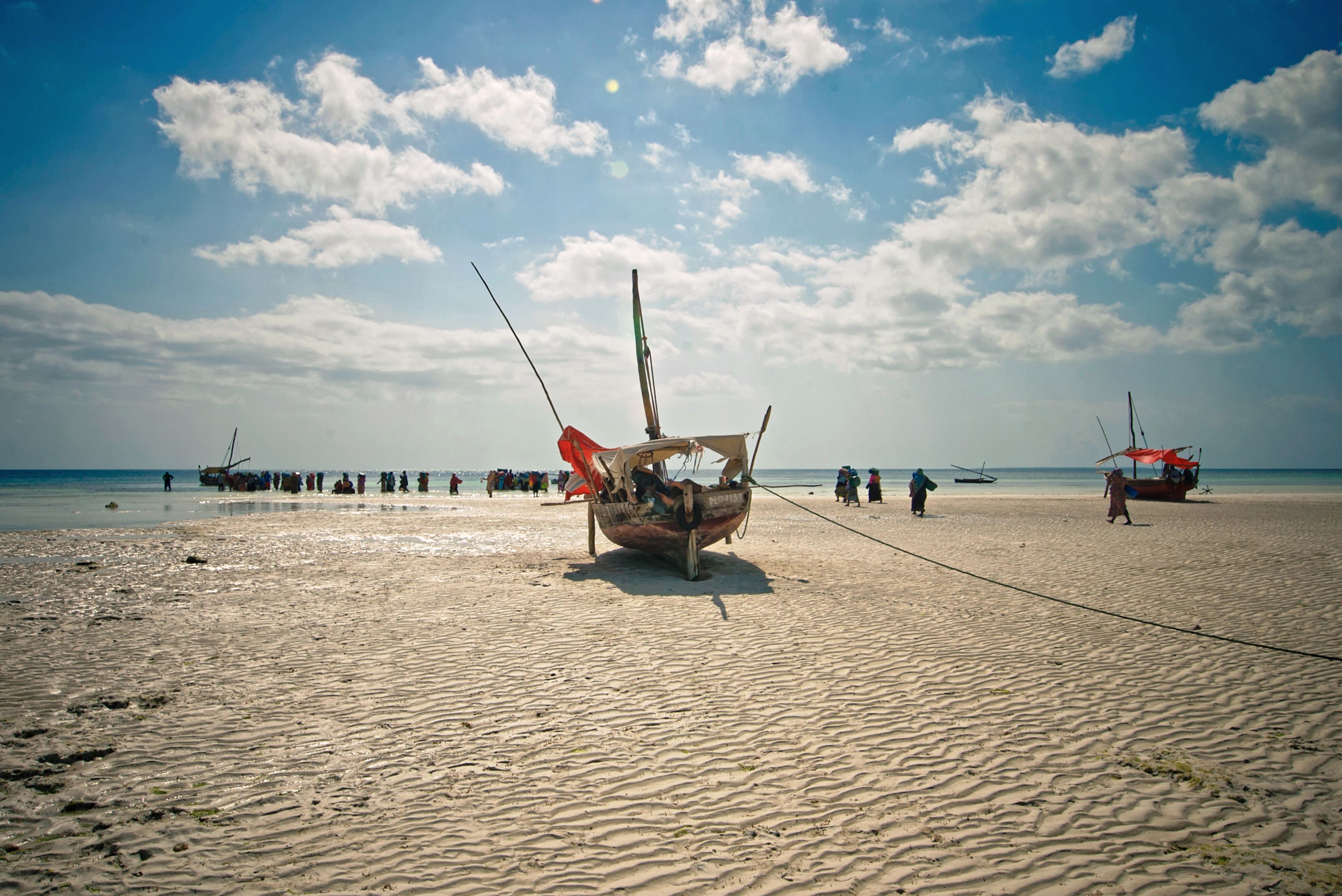
The tides are not a flaw in Zanzibar; they are part of its rhythm, and once accepted they shape the day in ways travellers come to appreciate. They simply need to be known about before you book.
The Best Time to Visit Zanzibar
Two strong windows. One window to actively avoid.
- June to mid-October (cool dry season): daytime 26–28°C, low humidity, steady south-easterly Kusi trade winds. The best beach window for travellers who dislike heat. Excellent diving on Mnemba and Pemba.
- December to February (hot dry season): daytime 30–33°C, calmer seas, the warmest swimming. The strongest single window for honeymooners and the most popular Christmas escape from European winters. Higher prices.
- Mid-March to mid-May (long rains): avoid. Heaviest rainfall of the year, many beach hotels close for refurbishment, dive visibility drops sharply.
- November (short rains): brief afternoon showers, otherwise pleasant. Strong shoulder-season value.
For a deeper month-by-month framework across all of Tanzania, see our guide to the best time to visit Tanzania.
Activities Beyond the Beach
Most clients arrive intending to do nothing and end up doing more than they expected. The activities below are the ones our team consistently recommends.
Diving and Snorkelling
Mnemba Atoll off Unguja's northeast coast is the most celebrated single dive site, with reliable turtle, octopus, ray, and reef-shark sightings. For serious divers, Pemba Island is the destination — wall dives, drift dives, and visibility that regularly exceeds 30 metres. Mafia Island Marine Park hosts whale sharks from October through March; for many divers, this is the single most memorable encounter Tanzania can offer.
Dhow Cruises
The traditional Swahili sailing dhow is to Zanzibar what the gondola is to Venice — touristy, photographed to exhaustion, and still worth doing. The right version is a sundowner cruise with a private dhow rather than a packed tourist boat. Two hours, an hour either side of sunset, with a cooler of drinks and the boat tilting under canvas. Approximately USD $80 to $200 per person depending on group size.

Spice Tour
A working plantation in central Unguja, with cinnamon bark stripped from a tree in front of you, vanilla pods cut open, peppercorns rubbed between fingers. Two to three hours, often combined with a Stone Town walking tour. Touristy in execution — but the spices are genuine, and the historical anchor of the island makes it worthwhile.
Jozani Forest
Zanzibar's only national park, and the only place in the world to see the Zanzibar red colobus monkey — an endemic primate found nowhere else on Earth. Approximately 2,500 individuals remain. Visits last two to three hours. Combine with a mangrove boardwalk and a stop at one of the spice plantations on the way back to the east coast.
Prison Island and Tortoise Sanctuary
A 30-minute boat ride from Stone Town to a small island home to a colony of Aldabra giant tortoises — some over 150 years old, gifted by the Seychelles in the late 19th century. Worth a half-day for travellers with children, less essential otherwise.
Where to Stay — Matched to the Traveller
Most accommodation guides list properties by price tier. We find a match-by-traveller-type framework produces better outcomes:
For Honeymooners
The Palms (Bwejuu — adults-only, ten villas, plunge pools), Mnemba Island Lodge (private island ultra-luxury), Zuri Zanzibar (Matemwe — modern luxury with three-bedroom villas), Pongwe Beach Hotel (boutique, value-honeymoon).
For Families
Baraza Resort & Spa (Bwejuu — kids' club, large pools), Breezes Beach Club (family-friendly, activity-heavy), Diamonds Star of the East (all-inclusive). The east-coast lodges with strong pool infrastructure are the right call for families with younger children — the tides are less of a concern when the pool is a few steps away.
For Divers
Matemwe Lodge (the closest base to Mnemba Atoll), Manta Resort on Pemba (purpose-built dive resort), or one of the dedicated dive lodges on Mafia Island.
For Stone Town Culture
Park Hyatt Zanzibar (waterfront, modern luxury inside heritage buildings), Emerson on Hurumzi (boutique heritage on a rooftop, no pool, unmatched character), Tembo House (mid-range, original wooden carved doors).
What a Zanzibar Holiday Costs
Zanzibar is meaningfully more affordable than the Maldives or Seychelles, and meaningfully more expensive than mainland Tanzania. The fee structure for a typical seven-night beach holiday, all-in:
- Tanzania visa: USD $50 per person ($100 for US citizens), single entry.
- Mid-range beach hotels: $180–$350 per room per night, half-board.
- Luxury beach resorts: $600–$1,500 per room per night.
- Ultra-exclusive private islands: $2,500+ per night (Mnemba), reaching $25,000+ at Thanda Island.
- Domestic flight (Arusha–Zanzibar): $250–$400 per person one-way.
- Daily activities & meals beyond half-board: $80–$200 per person per day.
For a typical seven-night Zanzibar holiday, expect $2,500 to $7,000 per person depending on tier — with the wide range explained almost entirely by accommodation choice. A combined Tanzania safari + Zanzibar trip of 10 to 12 nights typically lands at $8,000 to $18,000 per person.
Combining Zanzibar with a Tanzania Safari
The classic Tanzania itinerary is safari then beach — and there is good reason for the order. After six or seven days of dawn game drives, dusty roads, and adrenalin, three or four nights on a Zanzibar beach is exactly the kind of physical and emotional decompression that turns a good trip into a great one. Our most-requested structure:
- Days 1–2: Tarangire — elephants and baobabs as a soft opening.
- Days 3–4: Ngorongoro Crater — two nights on the rim, two descents.
- Days 5–8: Serengeti — central plus the migration zone of the moment.
- Days 9–12: Zanzibar — north coast or east coast, depending on tide preference.
Logistics are easy: a domestic flight from the Serengeti's airstrips connects via Arusha to Zanzibar in a single day, or via Dar es Salaam in slightly longer. Visa is single-entry valid for the whole trip. For the safari side of this itinerary, see our complete guides to the Serengeti and the Ngorongoro Crater.
The Bottom Line
Zanzibar rewards travellers who choose the right beach for their preferred experience, accept the tides as part of the rhythm rather than a defect, and treat Stone Town as essential context rather than an afterthought. Pair it with a Northern Circuit safari, plan seven nights, and book between June and October or December and February. The Indian Ocean does the rest.
It is, for almost every client we send, the chapter of the trip they say they want to repeat first.